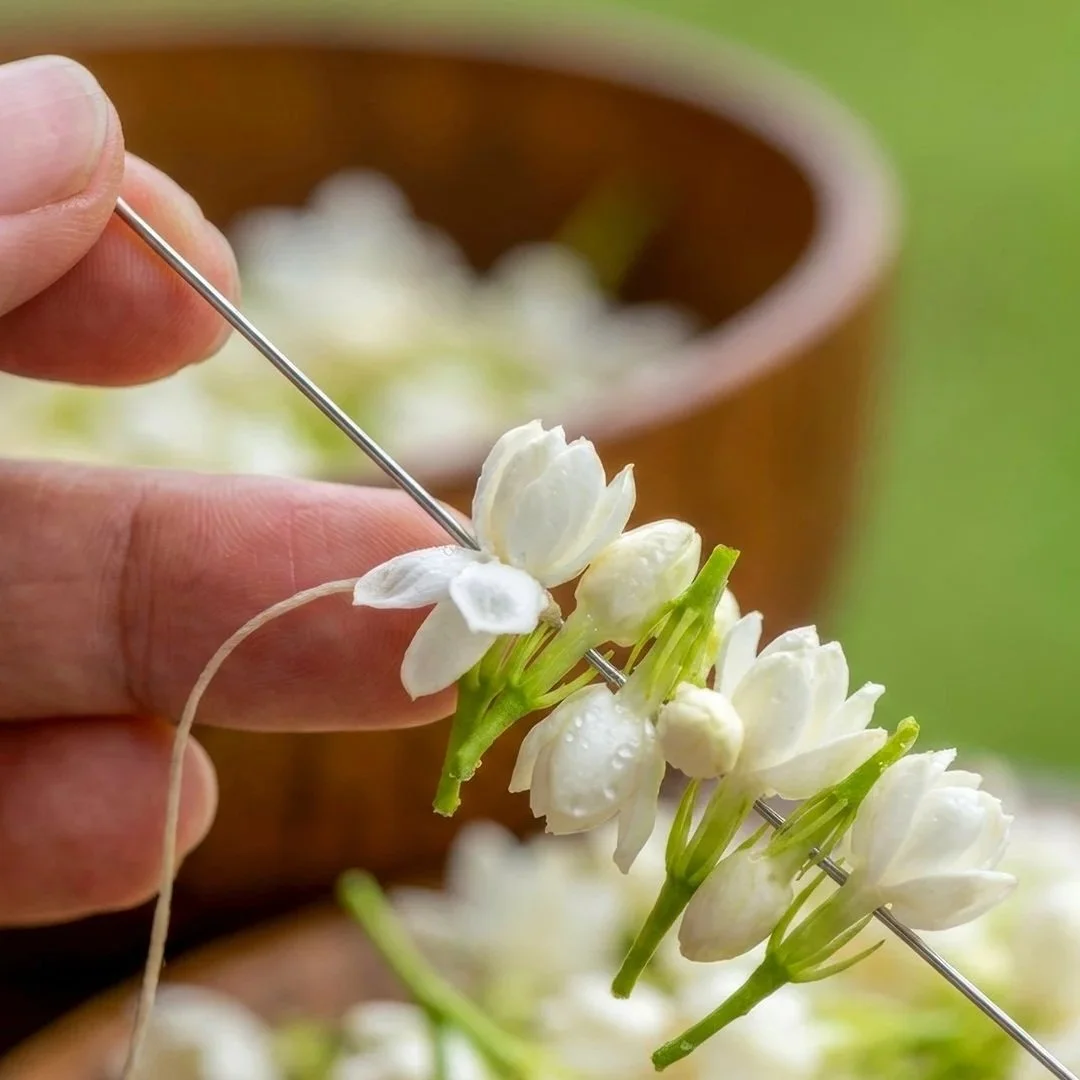

Sampaguita, the Philippine national flower, is at the center of Megaworld Global Hotels & Resorts’ effort to connect Filipino hospitality, procurement, and community livelihoods.
It had been raining since before dawn. At six o'clock on a Monday morning, Charlene Go-Co, Head of Marketing Innovations at Megaworld Global Hotels & Resorts (MGHR), and Nico Velasquez, the group’s Director of Public Relations, stood in the mud of a small farm in San Pedro, Laguna. They had a camera crew and very little time. The city’s agriculture office had already warned them that delaying the shoot could mean missing the bloom entirely. They would have to wait several weeks.
A week earlier, then-Managing Director Cleofe Albiso had asked Go-Co for a teaser campaign by "the following Friday." MGHR was preparing to build its new brand of service around the Sampaguita, the Philippines' national flower, and wanted to stake out the idea quickly. Go-Co found a YouTube video of a Sampaguita farm in San Pedro and messaged the owner, who replied within the hour.
The owner, Manang Filomena, was a former factory worker. For seven years, she had spent her savings to keep the farm going, picking blooms before sunrise as her family always had. She did not soften the picture. San Pedro still carries the title “Sampaguita Capital of the Philippines,” but most of the farms that earned it have disappeared. She said some of the Sampaguita flowers sold in San Pedro now come from neighboring towns.
On the same day, Go-Co and Velasquez met Engr. Enrique "King" Layola, who heads San Pedro's Office of the City Agricultural and Biosystems Engineering. The meeting ran much longer than a courtesy call and became a long conversation about the flower’s decline, the people who still grow it, and what a hotel group’s demand might do for both.
By their own account, Go-Co and Velasquez drove back to Manila with a different view of the project. The brand idea now carried a responsibility to the flower and to the growers it depended on.
Velasquez later called the visit a wake-up call. "We're not celebrating the fact that we’re losing it,” he said. “This is where what we do matters even more."

Executive Chef Christian Carpio holds a bowl of Sampaguita buds used in Savoy Hotel Manila’s Sampaguita-infused dishes.
An Integration Problem Before It Was a Brand Idea
It is easy to read the Sampaguita program as a branding exercise. Its origins point to something more operational. The program began as an answer to an integration problem, which helps explain why MGHR built it into departments instead of keeping it inside a campaign.
Around 2021, MGHR, then called Megaworld Hotels and Resorts, operated 10 properties. Some had long histories. Richmonde Hotel, for one, had been open for 26 years. But the hotels ran as separate businesses, each with its own standards and little contact with the others. Albiso was tasked with integrating them.
The portfolio spanned business hotels, lifestyle properties, and resorts. Folding them under one name risked flattening brands with established market positions. MGHR chose a different route: a shared service philosophy that could sit across every brand without replacing any of them.
The pandemic shaped the tone of that philosophy. Go-Co links the effort to bayanihan, the Filipino tradition of neighbors working together. The shared philosophy gave 10 very different properties a common anchor in homegrown pride and the comfort of "being home." The team mentioned Jollibee as a benchmark for a brand that carries Filipino identity at scale, including overseas. The tagline drew on a household habit most Filipinos know well, opening the door and inviting guests to eat: "Our heart, your home."
Choosing A Symbol With Built-In Meaning
The idea grew out of a Department of Tourism wellness conference where a previous director heard a discussion on designing experiences around the five senses. Back at MGHR, the team asked how a national symbol could carry that idea into a hotel. They considered several options and chose the Sampaguita.
The choice rested on a simple advantage: for many Filipinos, the flower is already tied to many personal memories. Go-Co recalls Sunday Mass as a child. Her parents bought Sampaguita garlands from a vendor outside the church. Her mother hung hers near the air conditioner to scent the house. Her father hung his from the car's rearview mirror.
"Sampaguita represents devotion, purity, fidelity, and divine hope," she said. "It is not just a flower but a symbol that embodies many of the best traits of Filipinos. It may be a small flower, but it reflects our uniqueness."
That kind of attachment is hard for any brand to manufacture, and MGHR did not have to. It already exists among Filipino guests and associates, waiting for something to bring it back. Scent became central to the design for that reason. "The power of scent brings the fastest rush of nostalgia,” Velasquez said, “grounding you in your purpose and values."
The flower also gave the group a set of values. Associates wear a five-petal Sampaguita pin. The four petals stand for Love, Honor, Dignity, and Healing. The fifth carries the Philippine flag and is worn facing the heart. According to Velasquez, guests often ask about the pin, turning associates who wear it into storytellers.

MGHR associates wear a five-petal Sampaguita pin that reflects the values at the core of the group’s brand of service.
How the Idea Moved Into Operations
Many cultural programs stay in the lobby. MGHR built the Sampaguita brand of service, launched in July 2023, to run across every department, moving a cultural symbol from ornament into operations. That level of full integration is still rare in the industry, where cultural symbols often appear as decor rather than an operating discipline.
The most important decision was about ownership. Each senior leader took responsibility for one sense: sight, smell, sound, touch, or taste. That moved the idea out of marketing and into the departments that handle daily operations: housekeeping, engineering, food and beverage, and the front office. These are the departments where daily habits form, and where programs either take root or slowly fade.
Guests meet the flower through each sense. Floral displays and Sampaguita-inspired design set the look. Public spaces play original Filipino music inspired by kundiman, the devotional love song, and harana, the traditional courtship serenade. Arriving guests receive Sampaguita-scented cold towels, and spa treatments use Sampaguita-infused oils.
Smell and taste depend on recurring purchases. They are where the program’s economics and its supply chain become visible.
Scent as a purchasing decision
The signature Cool Sampaguita scent blends Sampaguita oil with eucalyptus, peppermint, and complementary notes. MGHR developed it with Dwellbeing, a social enterprise that makes organic home-care and fragrance products while supporting livelihoods in underserved communities.
To date, MGHR has diffused 452 gallons across lobbies, lounges, and public restrooms, spending PHP 2,678,772 (about USD 42,015). Every hotel buys fragrance. What distinguishes this program is where the money goes next. Dwellbeing directs part of its proceeds to feeding programs run by Project PEARLS, a nonprofit serving underprivileged children and families. Through that link, Velasquez said MGHR's scent purchases have helped fund more than 10,000 family meals since 2023. As Dwellbeing founder Cherilyn Bendicion put it, “The purpose of developing the Sampaguita signature scent was really to support our NGO beneficiary, Project PEARLS.”
The partnership also produced spillover effects beyond the hotels themselves. Public interest in the fragrance prompted Dwellbeing to develop its Flora Filipinas Sampaguita personal care line, now among its most popular products. It later took on a circular dimension when retired linens from Belmont Manila were repurposed into Flora Filipinas flower labels, creating additional livelihood for women in marginalized communities.

MGHR’s signature Cool Sampaguita scent was developed with Dwellbeing, linking a routine hotel purchase to a wider social impact chain.
Taste as a culinary experiment
The kitchens faced a harder task. Sampaguita flower is rarely used in professional cooking, so MGHR's culinary teams had to learn how it behaves under heat, what it pairs with, and how much is too much.
Chef Franco Martin Lopez describes the learning curve. "Working with our National Flower has been both humbling and exciting. For many chefs, myself included, Sampaguita is unfamiliar territory, rarely encountered in culinary school or our past gastronomic experiences. While we understand heat, acidity, and flavor chemistry, Sampaguita challenged us to experiment and discover its full potential. The secret is restraint. Used subtly and sparingly, its elegant aroma and distinctive taste can be as delightful as other edible flowers. Its fragrant notes also remind me of vanilla, whose distinct character blends beautifully with many flavors."
Sampaguita buds and extracts now appear in desserts, teas, baked goods, and cocktails. Since June 2023, MGHR has recorded 260 kilograms of fresh and dried Sampaguita consumption. Fresh blooms account for 192 kilograms, or about 74% of the total. 2025 was the highest full calendar year on record, at 86 kilograms. Sampaguita menu items have generated PHP 8,467,847 (roughly USD 132,875) since launch.
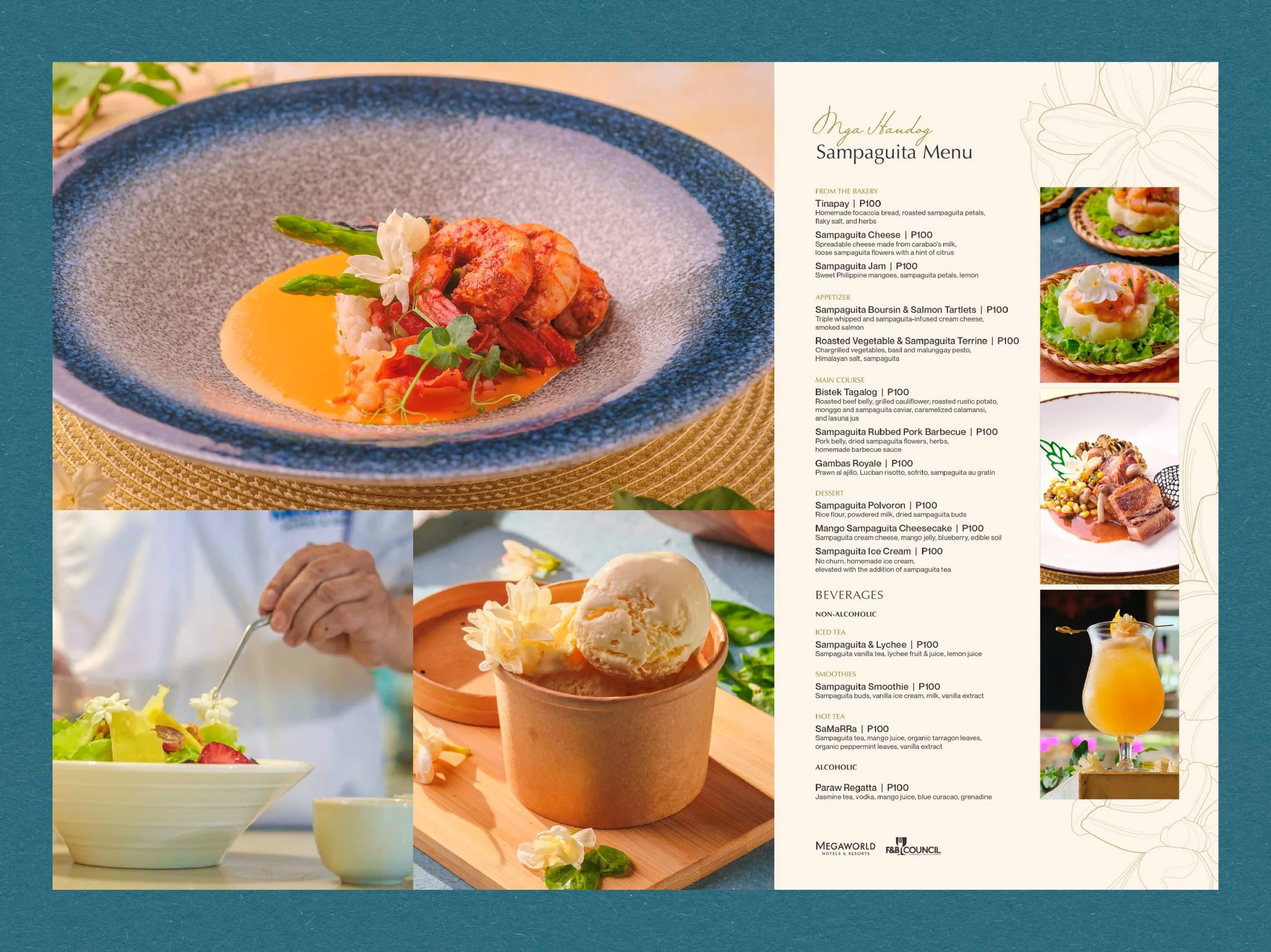


Sampaguita-inspired dishes and drinks are one of the most visible ways the program reaches guests across MGHR properties.
The Culture Beneath the Experience
A sensory program is only as strong as the people who deliver it. MGHR built the Sampaguita layer on an internal framework it already had: the Circle of Happiness, which centers on Love for Self, Work, Family, Country, and God. The group has earned Great Place to Work certification in consecutive years. In 2025, 90% of its employees affirmed it as a great place to work, compared with a Philippine average of about 65%. The certification reflects the broader culture, not the Sampaguita program alone. Still, it suggests the program landed on fertile ground.
Corporate Sustainability Manager Karlo Evangelista made the point in my earlier interview with him for Travel Asia Now, saying initiatives only last when people embrace them. "It's easy to think of what projects to implement and spend money on, but if people don't embrace these initiatives, then they won't be sustainable,” he said. “So it's about culture, not just the program."
Managing Director Anna Vergara places the program in a broader cultural moment, emphasizing that its values matter most when they are carried forward as Filipino hospitality modernizes. “I believe the Sampaguita advocacy comes at a time when we Filipinos need to be reminded of the values that keep us grounded, especially in challenging times,” she said. “As Filipino hospitality evolves alongside international standards, we must find meaningful ways to practice and pass on these values to future generations of guests and associates. Because while the way we deliver hospitality may change, the values that make us Filipino should always remain.”
Socrates Alvaro, Managing Director and SVP for Operations, sees the test in the workforce. "I believe the true strength of our Sampaguita advocacy lies in how our people bring its values to life every day. Love, Honor, Dignity, and Healing should not simply be principles we talk about, but values reflected in how we serve our guests, manage our operations, and care for our fellow associates. As our workforce grows and new generations enter the hospitality industry, our responsibility is to lead by example and make these values part of our service culture."
Divine Delos Reyes, VP for People Management and Development, connects the program to how associates see their own work: "Our responsibility is to keep creating spaces where associates can grow with purpose, take pride in the destinations they represent, and carry forward that genuine sense of family that makes Filipino hospitality our own."
This is where many heritage programs often fall short. They teach staff what to say. MGHR set out to teach associates what the flower means, train them, and then give them a pin that invites guests to ask.
From Brand Standard to Community Partnership
Go-Co sums up the shift in MGHR’s own terms: "The Sampaguita is… more than anything, it is an advocacy. It was our signature brand of hospitality, now turned into an advocacy."
The planting program is the clearest sign of that external ambition. Since 2023, MGHR and its corporate, government, and community partners have planted 7,738 Sampaguita seedlings across five Philippine regions. CALABARZON (Calamba, Laguna, Batangas, Rizal, and Quezon), home to San Pedro, accounts for 5,010. Metro Manila follows with 1,053, then Western Visayas with 825, Central Visayas with 450, and Central Luzon with 400.
Guests now take part as well. Through the "Petals to Purpose" campaign, MGHR had recorded 4,079 donated seedlings as of November 1, 2026, valued at PHP 249,810 and contributed by an estimated 4,000 individual donors. The design is concrete: a guest pays for one plant, and that plant goes into the ground in a named place.
Project PEARLS founder Melissa Villa says the partnership has differed from the one-off CSR efforts many nonprofits see. “Traditional CSR often ends with a one-day event and a photo. MGHR chose to stay,” she said. That continuity has created room for livelihood experiments, not just symbolic events. After learning to make polvoron (a crumbly Filipino milk shortbread) with toasted Sampaguita, some women in Project PEARLS communities began developing their own flavors and selling them for additional income. Villa said the group hopes to expand that work into a wider line of Sampaguita-infused products.


Through its partnership with Project PEARLS and Dwellbeing, MGHR has tied parts of the Sampaguita program to feeding and livelihood support in underserved communities.
Southwoods: Testing the Livelihood Model
The flagship site is a 4,300-square-meter Sampaguita Park in Southwoods City, Biñan, Laguna. It was developed in partnership with Global-Estate Resorts, Inc. and the Rotary Club of Biñan, and was planned from the start as a livelihood project first and a showcase second.
Thirteen months after planting in August 2025, the plants have begun to bloom in useful quantities. The park has just under 2,000 seedlings, including 100 planted to replace those that did not survive. MGHR funded the fencing, and the partners are seeking a sponsor for a gazebo.
Serge Igona, Past President of the Rotary Club of San Pedro, describes the next stage: "Right now, three workers are alternating to maintain the park,” he said. “In the coming months, as the Sampaguita becomes bigger and more productive, we will need more workers to maintain the park and to pick the sampaguita in the morning. We will try to teach them how to make sampaguita garlands as part of their livelihood."
The Rotary Club of Biñan plans to form a Rotary Community Corps as the project's primary beneficiary. A portion of future proceeds is earmarked for scholarships for the workers' children. "This will be a long process, step by step, until we reach our goal," Igona said.


At Southwoods City in Biñan, MGHR and its partners are testing whether Sampaguita cultivation can support a longer-term livelihood model.
The View From City Hall
San Pedro's experience shows that MGHR is one actor in a greater local effort. The city once had about 7.5 hectares of Sampaguita farms and roughly 20 growers. Urbanization has reduced that to about one hectare and three active farms.
The local government has not tried to win back lost farmland. Instead, it has changed where the flower grows. Its "Sampaguita Pa More" and "Adopt a Sampaguita" programs, together with a nursery in Barangay Rosario and solar-powered irrigation, have moved cultivation into pots, containers, vertical gardens, and public spaces. Women, mothers, and young people take part in propagation, garland-making, and processing through groups such as the Samahan ng Magsasampaguita ng San Pedro, Makabagong Ina at Kababaihan (MIKA), and the San Pedro Agri-Workers Network.
Layola explains the thinking behind this approach. "San Pedro's identity has long been woven into the Sampaguita, but rapid urbanization posed a severe threat to our local farms and traditional livelihoods,” he said. “We reimagined cultivation by moving from traditional vast lands to urban household gardening and community-managed nurseries. Preserving the Sampaguita is not merely about protecting a national flower; it is about sustaining an economic lifeline for our garland makers, women's groups, and local families. Our collaboration with partners like MGHR proves that when the private sector, local government, and communities unite, we can revive cultural heritage while creating sustainable, community-driven livelihoods for generations to come."
The city lists its growth opportunities as essential oils, teas, soaps, perfumes, urban greening, and heritage tourism. Hotels can create demand across several of these, from fragrance and amenities to food, landscaping, and guest experiences. For a local government looking for anchor buyers, a hotel group with nationwide purchasing power is a practical commercial partner, not just a sponsor.
Why Rooted Identity Has Commercial Value
Hotels across Asia face similar pressures. Distribution is consolidating, guest expectations are converging, and properties increasingly look alike. An identity rooted in place can be harder to replicate than design cues or standard sustainability messaging, particularly when it depends on supplier relationships, community partnerships, and institutional habits that take years to build. Many hotels reference local culture. Fewer have built it into procurement decisions, training systems, and daily operations.
According to Go-Co, the Department of Tourism has used MGHR as the first hospitality chain case study for "Filipinization," the practice of embedding local culture into brand and corporate identity. That recognition becomes more valuable as MGHR expands through internationally branded partnerships, including Mercure Mactan Cebu and the planned Mövenpick Manila Bay Westside.
The program also withstands scrutiny. Corporate and MICE buyers are increasingly wary of vague sustainability claims. A program that can report kilograms purchased, meals funded, and seedlings planted by region is far easier to defend than a values statement on a website. MGHR's broader sustainability approach follows the same discipline. Its switch to renewable power through Meralco's Mpower, for example, cut energy costs by 16%. The Sampaguita program operates within an organization that already treats measurable outcomes as the minimum standard, not an optional add-on.
Planting for the next generation
On July 30, 2026, more than 200 students, interns, faculty, alums, and MGHR leaders planted 250 seedlings at the entrance of the University of the Philippines-Asian Institute of Tourism in Quezon City. The institute is widely recognized as Southeast Asia's first degree-granting tourism school, and future hoteliers now pass the flower on their way to class.
Similar efforts are also taking place across MGHR’s portfolio. In Pasay, for example, Savoy Hotel Manila carried the advocacy into its own destination through June 2026 plantings at two historic schools.
At the planting, Cluster General Manager Jun Justo said that when the project launched in 2023, the group "honestly didn't imagine how far it would go." Then he added: "This project was never about our brand. It became a symbol of who we are."
MGHR is also developing a children's storybook about the national flower, extending the effort into education.


MGHR’s planting initiatives extend the Sampaguita program beyond hotel operations and into schools, public spaces, and community sites.
What Hospitality Leaders Can Take From It
For hotels elsewhere in Asia, the lesson is not to find a flower. It is to identify a cultural asset your destination could lose, and then run your operations in a way that helps keep it alive.
Five practices from MGHR's experience apply widely.
1. Start with a cultural symbol people already carry in memory.
The Sampaguita works because it already belongs to Filipino family life: Sunday Mass, garlands on the rearview mirror, a scented living room. Go-Co's own childhood memories show the depth of that attachment. An invented layer of "local flavor" can look distinctive at launch, but it's expensive and shallow to maintain.
2. Give every department a piece, and give staff the meaning, not just the script.
MGHR assigned senior leaders to one sense each: sight, smell, sound, touch, or taste. That put the program in housekeeping, engineering, food and beverage, and the front office, not just marketing. A single champion is a single point of failure; shared ownership gives the program more ways to survive when one department comes under pressure. The pin turns that internal culture into a guest-facing cue. It gives associates a story to carry and it invites guests to ask about it.
3. Decide in advance whether procurement will defend the story.
Authentic sourcing doesn't always win on cost, consistency, or convenience. MGHR's scent purchasing shows one way to build the story into the budget. The group developed its signature fragrance with Dwellbeing, a social enterprise, so that a routine operating cost is linked to a documented social contribution. Other operators should make that call early, before an urgent purchase forces it. If a hotel group won't tolerate some friction in the system, the community narrative will collapse under operational pressure.
4. Treat agricultural reality as a design constraint.
Any hospitality program tied to farming has to plan for mortality, weather, seasonality, and uneven yield. Southwoods shows it in miniature: 100 of the park's seedlings had to be replaced, and San Pedro officials report high losses among young plants. Urbanization is also an issue. The city responded by moving cultivation into pots, containers, and public spaces. Diversified planting sites and a guest experience that can flex when harvests fall short belong in the design brief from the start.
5. Partner for the capabilities you lack, and keep reinventing.
Hotels aren't experts in propagation, community organizing, or livelihood development. MGHR leaned on San Pedro's city government, the Rotary Clubs of Biñan and San Pedro, Dwellbeing, and Project PEARLS. Transactional CSR may generate publicity, but long-term partnerships make a model hold. Those relationships also keep the program from feeling finished, which is when it starts to lose energy. Petals to Purpose, the Southwoods park, and the UP-AIT planting each gave the program a new form, a new audience, or a new point of entry.
What Happens Next
Three years after that rainy Monday, the Sampaguita is in lobby diffusers, dessert menus, and staff pins. It lines the entrance of a tourism school and fills a fenced park in Biñan, where three workers take turns tending around 2,000 plants.
Velasquez names what was at stake: "When you say goodbye to the Sampaguita, you say goodbye to a proud symbol of what makes us Filipino."
For hospitality leaders across the region, the next three years will matter more than the first. The real measure is whether growers earn more, whether more seedlings survive, and whether the standard holds as MGHR expands across more properties and brands. If so, the group will have built more than a signature scent. It will have a model other operators can study and adapt.
All photos by Megaworld Global Hotels and Resorts (MGHR)