The Overtourism Problem: How Smart Operators Can Rebalance the Heatmap



These images are familiar by now: a selfie queue snaking up the steps of a Kyoto temple at dawn, a longtail boat idling in a cove in Koh Phi Phi so crowded the turquoise water has turned murky, a Balinese rice terrace cordoned off because the terraces themselves are collapsing under foot traffic.
These are not anomalies. They are symptoms of a structural problem that Asia's travel industry has deferred for too long, and can no longer afford to.
Asia Pacific (APAC) has emerged as the undisputed engine of global travel growth, with the region accounting for 36% of all OTA sales worldwide and posting some of the fastest expansion rates across both international arrivals and online bookings heading into the first half of 2026.
By the numbers, it looked like success. By the map, it told a different story: legacy destinations such as Bangkok, Phuket, Chiang Mai, and Bali continued to absorb a disproportionate share of visitors, while hundreds of equally compelling places remained invisible to mainstream tourism flows.
The geopolitical shocks of early 2026 have simply underscored how fragile this model is. US and Israeli strikes on Iran in late February triggered airspace closures and mass rerouting across key Middle Eastern corridors, driving up fares, stranding travelers, and reminding Asia just how dependent its long-haul demand is on a handful of transit hubs and flight paths.
Thailand’s Ministry of Tourism and Sports has warned that an eight-week conflict could cost the country nearly 600,000 visitors and about US$1.1 billion in tourism revenue, with a conflict extending beyond three months potentially slashing arrivals by a quarter. Vietnam and the Philippines, also heavily reliant on Gulf-transit long-haul traffic, have reported similar softening in forward bookings.
Asia has spent the better part of the past three years managing the consequences of too many visitors in too few places. Now, its most tourism-dependent economies face a sudden contraction of demand from source markets that were only just returning.
When visitor flows and aviation corridors are both concentrated, destinations prove simultaneously overwhelmed and exposed — two symptoms of the same underlying failure to distribute demand equitably.
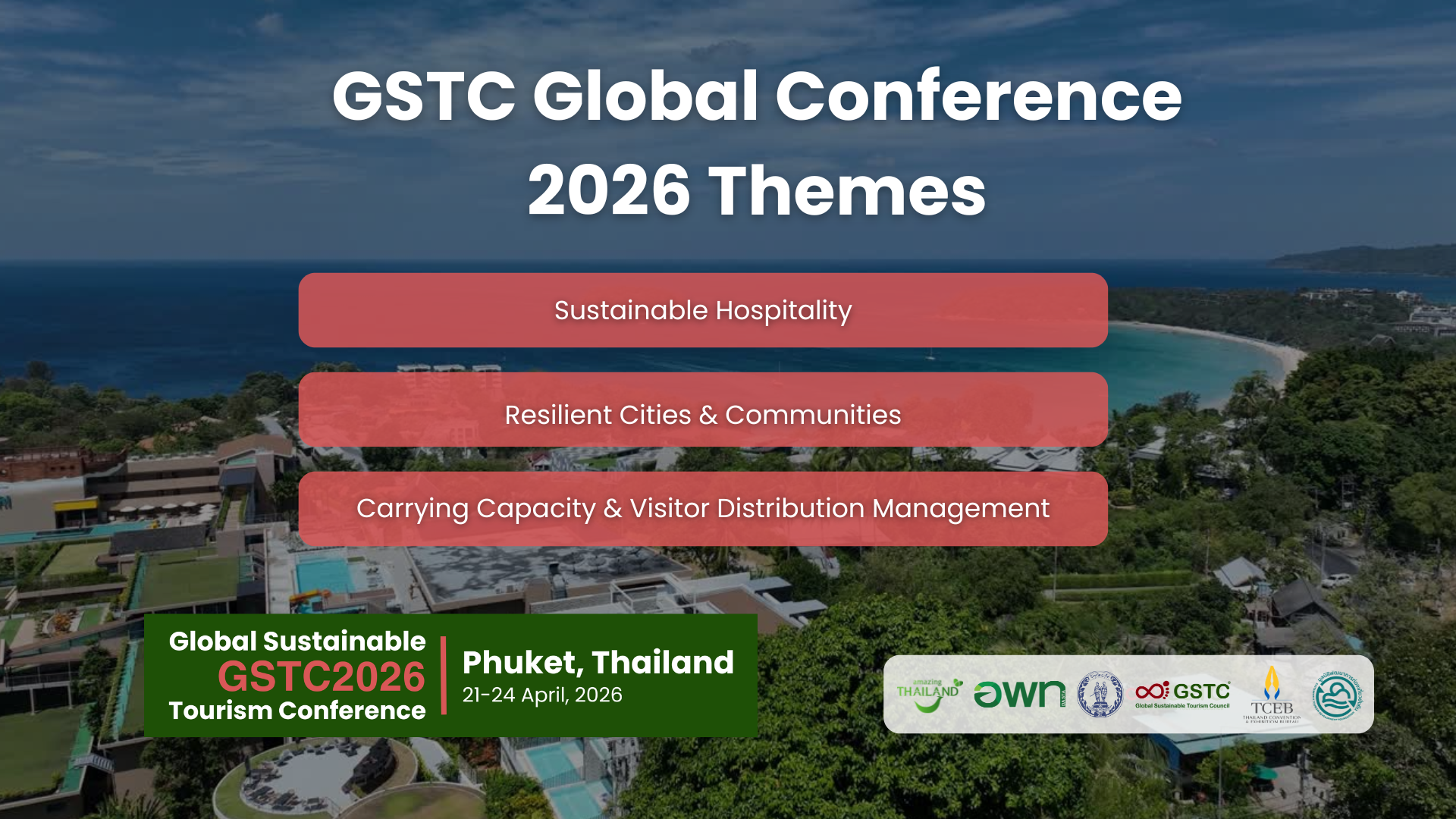
It is precisely that failure — and the urgency of addressing it — that shaped the agenda for the GSTC2026 Global Sustainable Tourism Conference taking place in Phuket this April.
"GSTC selected these three themes because they reflect some of the most urgent and interconnected issues in tourism today," says Randy Durband, GSTC CEO.
The three themes — sustainable hospitality, resilient cities and communities, and carrying capacity and visitor distribution management, as Durban highlighted, “point to a more balanced and practical approach to tourism development, one that supports businesses, communities, and destinations alike.”
The Volume-to-Values Shift
The idea that destinations have limits is not new.
Carrying capacity entered the academic debate in the 1960s. Bhutan institutionalized it as a national tourism policy as far back as the 1970s when the country welcomed its first visitors under a deliberate "high value, low volume" framework.
What has changed is not the concept. It is the urgency, the data tools to act on it, and slowly, the political will.
For most of the industry's modern history, that will has been conspicuously absent.
Governments have used arrival statistics as the primary measure of tourism success, hotel groups have built revenue models around occupancy volumes, and airlines have structured routes around passenger density.
Each of these actors has had a structural reason to resist limits.
That resistance has not disappeared. But for the first time, it is being seriously challenged: by travelers who are voting with their itineraries, by platforms that can see where demand is concentrating before the damage shows, and by destination managers who have watched the impacts of tourism overflow play out in real time.
Carrying Capacity & Visitor Distribution Management sits at the heart of the GSTC2026 Conference this April, alongside Sustainable Hospitality and Resilient Cities & Communities. This signals that the global sustainable tourism community has moved beyond making the case for limits and appears to now focus on how to enforce them.
Two leaders at the forefront of that shift, both scheduled to speak at the conference, shared with us what implementation looks like from two very different vantage points, in the pre-event interviews with AST.


Left: Krishna Rathi, Regional Vice President at Agoda (L); Right: Siripakorn Cheawsamoot, Director-General of Designated Areas for Sustainable Tourism Administration (DASTA)
Data as a Redistribution Tool: Agoda's Platform-Level Approach
Few actors in Asia's travel ecosystem have a more granular view of traveler behavior than online travel platforms. Krishna Rathi, Regional Vice President at Agoda, describes a company trying to turn that view into action by using its platform to redirect demand.
The data signals are already pointing in the right direction. Agoda's 2026 Travel Outlook Report found that interest in secondary cities grew approximately 15% faster than in primary hubs, with lesser-known destinations accounting for 34% of all accommodation searches on the platform.
That last figure matters: it challenges the comfortable industry assumption that dispersed travel is a niche preference rather than a mainstream one.
"Travelers are ready for more dispersed patterns," Rathi notes. "Our focus is on ensuring that Agoda's platform is well-positioned to capture this demand."
Agoda is deploying AI not just to close a sale, but to shape what a traveler considers in the first place by surfacing destinations like Takamatsu in Japan and Rayong in Thailand for users whose search behavior suggests flexibility.
Most travelers arrive at a booking platform with a mood, a budget, and a window. That openness is exactly where demand can be redirected.
On the supply side, Agoda has expanded its non-hotel inventory, such as villas, boutique guesthouses, and homestays by 25%, offering the kind of accommodation variety that supports longer, slower trips rather than the transactional one-night stop that drives footfall without depth.
On the collaboration front, Agoda's partnership with World Wildlife Fund (WWF) through its Eco Deals program illustrates how commercial incentives and conservation goals can be structurally aligned rather than treated as competing priorities.
Travelers receive discounts of up to 15% at participating hotels; for every completed booking, Agoda donates US$1 to WWF conservation projects across Asia.
The program has raised US$2.89 million to date, with a 2026 target of US$1.5 million across ten Asian markets. It works precisely because it does not ask travelers to sacrifice anything — the financial incentive does the behavioral work.
A collaboration with the Tourism Authority of Thailand (TAT) took the same logic further, combining affordable stays with curated guides promoting secondary destinations during off-peak periods. Close coordination with local hotel partners ensured that capacity could scale where demand was being redirected. The outcome was a measurable shift in traveler flows, longer average stays, and broader economic distribution.
There is a harder question underneath all of this that the travel industry has not yet fully answered. Platform-driven redistribution can move fast. Destination governance often cannot. When bookings to secondary destinations outpace the waste management, transport, and community infrastructure that those destinations have in place, the industry risks exporting its concentration problem rather than solving it.
Rathi implicitly acknowledges this when he notes that promotion alone is not enough.




Photos by Agoda.
Standards as Infrastructure: DASTA's Governance-Level Approach
While Agoda operates on the demand side by influencing where travelers go, Thailand's Designated Areas for Sustainable Tourism Administration (DASTA) works on the supply side. DASTA ensures that these destinations are prepared to welcome tourists and have the authority to decline them when necessary.
DASTA has adopted the GSTC Destination Criteria Version 2.0 as the foundation for its strategic planning, built on four pillars: Sustainable Management, Socio-economic Sustainability, Cultural Sustainability, and Environmental Sustainability. Each of them is tracked through specific indicators rather than policy declarations.
Director-General Siripakorn Cheawsamoot describes a system that refuses to reduce carrying capacity to just about capping visitor numbers. What should be measured instead is whether tourism income is actually staying in designated areas, whether residents report improved well-being, whether cultural assets are being preserved, and whether the carbon footprint of tourism development is moving toward neutrality.
These dimensions are held together by DASTA's 4C framework: Community Benefits; Conduct Infrastructure Plan; Comply with International Standards; and Cross-Sector Collaboration, ensuring that the public sector, private companies, and community organizations are co-governing.
On visitor dispersion, DASTA's strategy is to build genuine pull factors in secondary destinations rather than redirect marketing budgets. Infrastructure investments, such as a cable car at Phu Kradueng National Park in Loei, a Skywalk and Solar Farm in Suphan Buri, and Salak Phet Pier in Tra, are designed to make secondary cities, including Chiang Rai, Nan, Sukhothai, and Songkhla, compelling on their own terms. Annual tourism calendars, developed at the community level, spread demand across the year by anchoring distinctive cultural events and festivals outside peak seasons.
Perhaps one of the most notable reframes is DASTA's approach to the tension between enforcing ecological limits and ensuring livelihoods. Rather than treating these as opposing forces, the organization inverts the premise: communities are encouraged to keep tourism as a supplementary income source, not their primary one. A community that does not depend on tourist volumes for survival is a community that can actually afford to enforce a cap.
"Economic income is not the only outcome of tourism development in communities," Cheawsamoot explains. "Equal importance is given to the conservation of local resources and cultural heritage, as well as to creating opportunities that foster a happy and resilient community."
It is a vision of tourism as a tool for community development rather than an end in itself. It represents a significant departure from the volume-maximization logic that has driven the industry for most of its recent history.



From left: Sukhothai, Thale Sop Songkhla Basin, Community Tourism in Nan. Photos by DATSA.
Toward a Coherent Toolkit
Placing these two approaches side by side reveals a clear diagnosis of where that system currently falls short.
Platform tools can redirect demand at speed and scale. But, for example, a 15% uplift in tour bookings in rural areas like Nan or Phatthalung in Thailand means very little if those destinations lack the waste management, transport links, and community capacity to absorb the increase in visitors responsibly. Redirected demand without prepared infrastructure does not solve overtourism; it relocates the problem.
Governance frameworks like DASTA's 4C model and the GSTC Destination Criteria give platform-level redistribution its structural meaning by defining what responsible visitor distribution actually looks like and building the conditions for it.
But governance frameworks, however well designed, cannot substitute for the community-level empowerment that determines whether dispersion serves residents or simply extends the industry's extractive logic into new territory.
The GSTC2026 Conference arrives at a moment when all three layers – booking platform capability, governance innovation, and community empowerment — are ready enough to spring into action. This is crucially important as the disruptions prompted by the Middle East conflicts have made the cost of inaction more pronounced.
The question facing the travel insiders gathering in Phuket this month is not whether carrying capacity matters. It is whether the industry can build the working coalitions needed to enforce it against the entrenched interests that have always benefited from ignoring it.
Asia's most visited destinations did not become overwhelmed by accident. They became overwhelmed because growth was consistently treated as a single-dimensional goal. Changing that by spreading demand, building community resilience, and treating slow travel as the default is the work that now needs to move onto the ground.
» » » Check out the program details and register for the conference here.