ASEAN-EU Sustainability Summit 2026: What Travel Must Act On Now

Camotes Islands, Cebu, Philippines (Photo by Provincial Government of Cebu)
Volatile energy prices, tightening EPR regulations, and climate-disrupted supply chains are hitting travel and hospitality operators’ P&Ls hard right now. For leaders across Southeast Asia, treating sustainability simply as an add-on risks higher operating expenses, compliance failures, lost investor confidence, and guests who quickly see through greenwashing.
The first ASEAN-EU Sustainability Summit 2026 in Cebu, Philippines, made the stakes clear. Chris Humphrey, Executive Director of the EU-ASEAN Business Council, put it directly in our exclusive interview: “Moving to more sustainable business and operating practices is a must. Not doing so will harm any business in the long run. For the tourism sector, tourists will increasingly look for hotels and resorts that have recognized sustainability practices and measures to reduce their carbon footprint.”
While not exclusively a tourism event, the summit cut straight to the operational realities facing travel and hospitality businesses today: intense scrutiny of sustainability claims, stringent packaging rules, and fragile supply systems. These pressures directly drive up utility bills, food costs, purchasing decisions, and long-term profitability for hotels, resorts, airlines, attractions, and destinations.
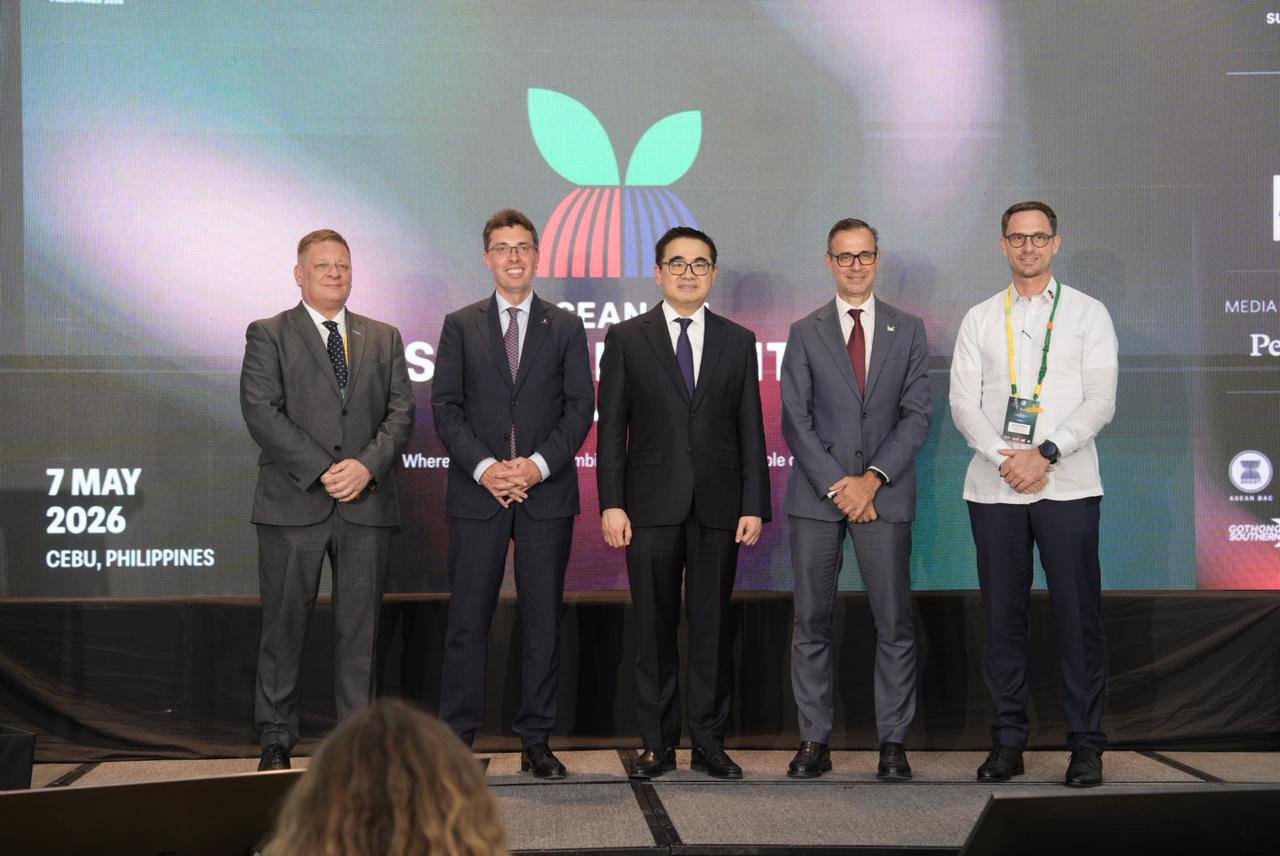
From left: EU-ABC Executive Director Chris Humphrey, EU Ambassador to the Philippines Massimo Santoro, Philippine Secretary of Finance Frederick Go, Mr. Paulo Duarte, ECCP President, and ECCP Executive Director Florian Gottein, at the ASEAN-EU Sustainability Summit 2026.
Why the Summit Matters to Travel and Hospitality
The discussions on energy transition, green finance, circular economy, sustainable trade, supply chains, and climate-resilient agriculture directly affect travel and hospitality operators.
Hotels consume massive amounts of energy and water. Resorts depend on stable food systems and healthy ecosystems. Destinations struggle with huge waste volumes, strained infrastructure, and climate exposure. Airlines and cruise operators are under pressure to reduce emissions.
When energy prices spike or weather events disrupt transport and agriculture, the impact shows up fast in food costs, maintenance budgets, operating margins, and day-to-day service delivery.
Owners expect stronger returns, guests quickly spot greenwashing, and investors demand evidence that sustainability claims are backed by operational discipline.
ASEAN-EU Cooperation Must Shift Towards Implementation
To address these compounding pressures, the summit highlighted the need to move from policy ambition to execution now. Regional leaders stressed integrating sustainability into economic development through cohesive planning and regional collaboration.
Indonesia’s Deputy Minister for National Development Planning, Leonardo Sambodo, emphasized this dual challenge: “The challenge for us is managing twin goals – achieving strong economic growth while reducing emissions. The only viable path forward is cohesive planning that integrates sustainability into every aspect of development.”
Philippine and EU representatives pushed for actionable steps. Secretary Robert Borje of the Climate Change Commission noted that current energy challenges present "an opportunity not just for investments to come into the Philippines, but an opportunity that provides co-benefits as we work towards a greener future and greener sources of energy.”
EU Ambassador to the Philippines Massimo Santoro added that synchronizing financial resources with climate targets is essential to "turning policy into real, on-the-ground impact."

Philippine Department of Finance Assistant Secretary Neil Cabiles (left) and Indonesian Deputy Minister for National Development Planning Leonardo Teguh Sambodoh (center) during a policy leaders’ dialogue moderated by ECCP President Paulo Duarte (right).

Philippine Climate Change Commission Vice Chairperson and Executive Director Robert Borje (left) and EU Ambassador to the Philippines Massimo Santoro (right) during a fireside chat on ASEAN-EU cooperation for climate resilience.
EPR is Here. How Hospitality Must Adapt
This shift toward measurable impact is already reshaping waste management. One of the strongest signals from the summit was the fast acceleration of extended producer responsibility (EPR). Across ASEAN, governments are enforcing policies that hold producers and value-chain participants accountable for the entire lifecycle of packaging and materials.
In hospitality, this directly impacts how properties buy, use, sort, and dispose of materials every day. Hotels, resorts, attractions, and event venues generate vast amounts of waste through bottled water, minibar items, takeaway food, amenities, cleaning supplies, supplier deliveries, and event materials.
Humphrey pointed to where policy is heading: as ASEAN member states further refine or develop their EPR policies, governments are likely to intensify efforts to mandate the recycling of certain materials like PET and aluminum cans.
He also highlighted a practical starting point: “Hotels, resorts and tourist attractions can already anticipate this by putting in place recycling collection points, and also moving to other materials such as refillable glass bottles for water. It is worth noting that many hotels in ASEAN already have such practices in place.”
Real preparation goes far beyond banning plastic straws or swapping mini toiletries. It requires mapping material flows through operations, rigorous sorting to avoid contamination, and overhauling purchasing decisions.
What Hotels and Resorts Should Execute Now
1. Audit the property’s packaging footprint.
Conduct a material audit across guest areas and back-of-house operations to identify the exact volume of PET bottles, aluminum cans, cardboard, food delivery containers, amenity packaging, housekeeping and laundry chemical containers, event waste, and supplier transit packaging entering the loading dock. This establishes the baseline for setting targets and regulatory compliance.
2. Build functional collection systems.
Bins in guest-facing areas form only a fraction of the solution. Collection and sorting also need to work in the back-of-house: kitchens, housekeeping areas, loading bays, banqueting spaces, and staff zones to prevent contamination and maintain high recovery rates.
3. Reduce before recycling.
Preventing waste delivers the strongest financial and environmental returns. Refillable glass water bottles, bulk amenities, and supplier take-back systems offer far more value than attempting to recycle disposable items.
4. Bring procurement into the conversation.
Hotels usually deal with waste after it's generated. EPR focuses on preventing waste before it's created. Procurement teams must require suppliers to disclose packaging composition and provide take-back or refill models before signing contracts.
Circular Economy as a Margin-improvement Strategy
The idea that low-impact operations inherently cost more is a myth. When done right, sustainability functions as an essential asset management tool. Capital deployed into resource efficiency protects margins against volatile utilities and supplies.
Humphrey addressed the financial mechanics: “Reducing the environmental footprint of a hotel or resort does not equate to increasing costs; indeed, moving to renewable energy sources for a hotel may well reduce costs over time, and moving to more energy-efficient equipment and processes provides a relatively quick return on investment.”
Humphrey also noted that “The European hospitality sector, and indeed Europe as a whole, has been practicing circular economy techniques and approaches for many years now.”
Drawing on European practices, ASEAN operators can adapt mature circular models through public-private collaboration, such as co-investing in localized recycling facilities to strengthen supply chains and support communities.
EU Approaches that ASEAN Hospitality can Adapt
Reuse and return systems
Partner with local bottlers and agricultural cooperatives to build closed-loop systems. Scaling these loops across multiple hotel brands in one destination creates the density needed to make them financially viable.
Rigorous buying standards
Circularity starts at the purchasing desk. Before issuing a purchase order, teams must evaluate if packaging is necessary, if the vendor accepts returns, and if the materials hold local recycling value.
Efficiency before aesthetics
Upgrading back-of-house efficiency often beats visible lobby projects. Heating, ventilation, and air conditioning (HVAC) systems consume 40% to 50% of a property's total energy consumption. Optimizing chillers and fixing building insulation delivers rapid, trackable payback.
Sustainable Sourcing Requires Supply Chain Integrity
Businesses can no longer treat supply chains as an external problem. A hotel’s risk profile depends on vendor resilience. Unreliable, untraceable, or resource-heavy supply lines create immediate financial, social, environmental and reputational exposure.
The summit’s wider discussion on supply chain resilience focused on governance, standards, and stronger cooperation between business and government.
Humphrey sees strong potential in closer EU-ASEAN cooperation here. “Europe and ASEAN have much to offer each other on this topic. The regions are complementary in that respect,” he said.
Where Europe offers mature regulatory and technological frameworks, ASEAN offers scale, agility, and the opportunity to build resilient systems from the ground up.
Food is one of the clearest examples. Humphrey emphasized that “securing food supplies and ensuring the quality and safety of the food are paramount. Increasing yields on farms, reducing wastage, and ensuring sustainable processing are things that ASEAN agriculture ministers are already looking at seriously. The European agri-chemical industry stands ready to assist in this.”
This aligns with the summit’s focus on climate-resilient agriculture and stronger animal health systems.
Cynderella Galimpin, Head of Animal Health for ASEAN, Korea, Australia & New Zealand at Boehringer Ingelheim, reinforced the economic value of agricultural resilience: “When we invest in prevention, we protect animal health, farmer livelihoods, and trade confidence at the same time.”
F&B leaders must question the efficiency and origin of every ingredient, prioritizing local producers who utilize climate-resilient methods. Key questions include:
Was it produced efficiently?
Is it seasonal?
Can its origin be verified?
Can the supplier maintain quality during disruptions?
Energy Serves as a Core Resilience Metric
The discussions linked energy transition with resilience, competitiveness, and cost stability. Humphrey stated the challenge clearly: “The tourism sector in ASEAN, like other services and industrial sectors, needs to push the accelerated greening of energy supplies across the region. This is the biggest area of concern.”
A better energy agenda for hotels and resorts
Cut demand first.
Optimize cooling, fix insulation, and upgrade kitchens to lower emissions and costs rapidly before investing in new generation technology.
Improve supply resilience.
Assess on-site solar, battery storage, and renewable electricity purchases to reduce exposure to grid disruption and price spikes.
Bring finance into the conversation early.
Engineering teams often know what should be done, but capital approval lags. Frame energy upgrades as operating margin measures, not just environmental projects, to secure capital approval faster.
Support cleaner aviation too.
Humphrey pointed to tourism’s dependence on air travel, saying that “adding voices to the push for the greater use of Sustainable Aviation Fuels (SAF) would also be welcomed.” Advocate for SAF through corporate travel policies and destination-wide initiatives to help decarbonize the broader travel ecosystem.
Five Actions Travel and Hospitality Businesses Can Take Now
For a practical starting point, these are the most useful takeaways from the summit.
1. Conduct an EPR readiness review.
Map packaging materials, collection systems, waste contractors, and supplier obligations to ensure compliance with evolving regulations and minimize disruptions.
2. Create a packaging reduction plan.
Address bottled water, food takeaway service, events, procurement packaging, and back-of-house consumables far beyond basic straw bans and guest amenity swaps.
3. Tighten supplier scorecards.
Assess vendors on traceability, packaging reduction, and continuity risk during all contract renewals.
4. Prioritize energy upgrades with clear payback.
Develop a shortlist of efficiency and renewable projects ranked by cost savings, resilience value, and ease of implementation. Then move them into the budget planning cycle.
5. Join regional policy conversations.
Ensure tourism and hospitality hold a strong, active voice in industry associations and business chambers, shaping future regulations.
Humphrey’s closing advice offers a clear roadmap: “For hotels and resorts, I would suggest continually reviewing your practices and procedures to see where they can be improved further to increase sustainability and reduce (your) carbon footprint.”
Applying this ongoing, consistent operational discipline will separate the truly resilient travel and hospitality businesses from the rest.