When Sustainability Meets Operations: Key Lessons from PHILHOST 2026
Many hotels can tell you what they stand for on sustainability. Fewer can tell you what they did when the vegetable supplier didn't show up, who in the property owns the carbon data, or how they explained a heat-exchange system to an operations team unfamiliar with the technology.
Those are different conversations. And PHILHOST 2026 (Philippine Hospitality on Sustainable Tourism) stayed firmly with the operational one.
Held on 2 July at Ascott Bonifacio Global City in Manila, the fifth edition of PHILHOST gathered senior hotel operators, developers, investors, designers, tourism officials, and sustainability practitioners around the theme Sustainability in Focus: Purpose. Impact. Action. The conversations went deeper than the usual agenda: how you source food when small farmers won't issue receipts, what happens if data ownership sits with someone whose main job is something else, what happens to a reef rehabilitation program if no one funds it, and how you convince an owner that sustainability is not just an expense line.
Here are the key takeaways from the panel discussions, and what they mean for your property.
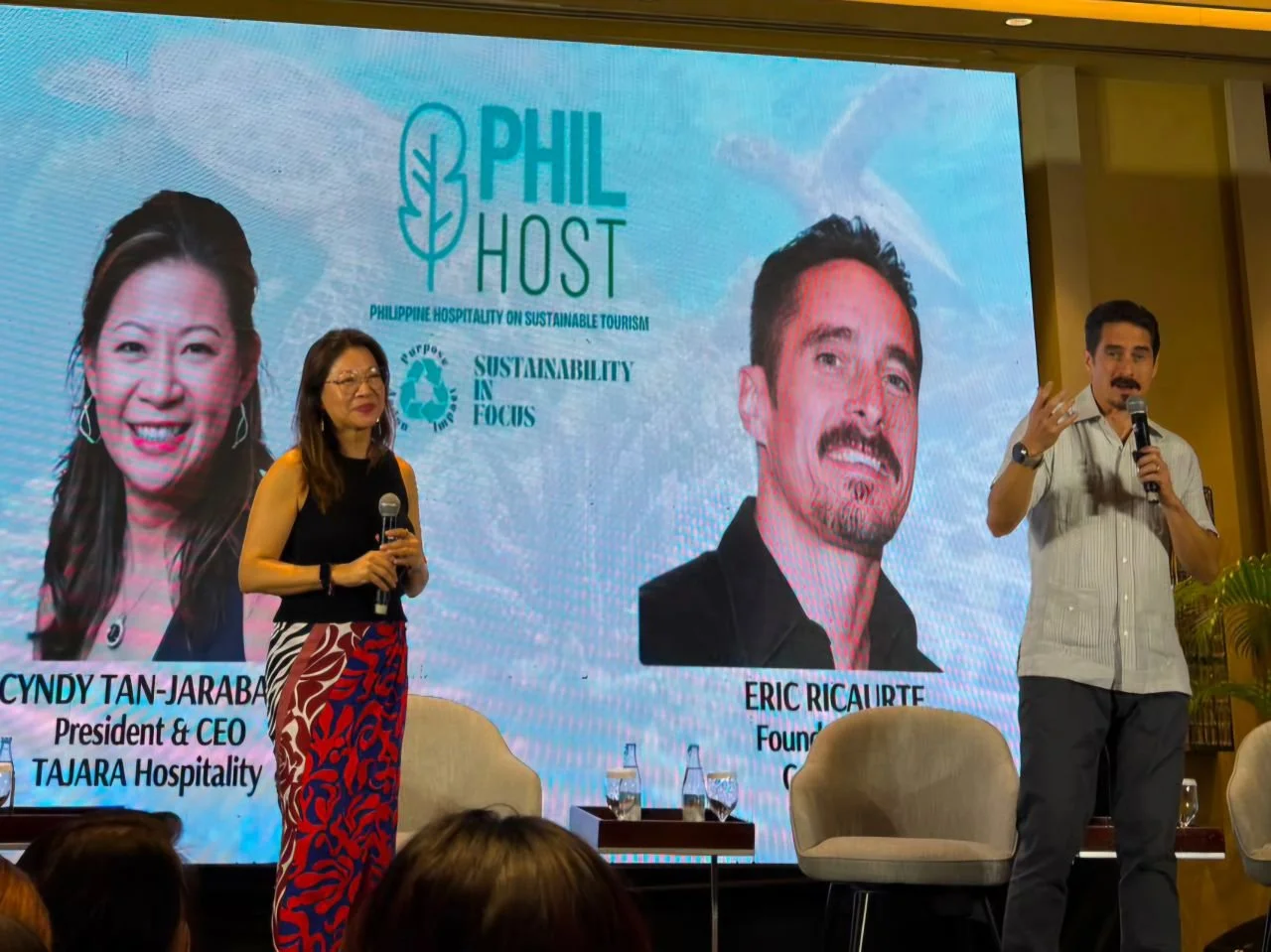
PHILHOST organizers. Cyndy Tan-Jarabata, CEO and President of TAJARA Hospitality, and Eric Ricaurte, CEO of Greenview. Credit: TIEZA
The Supply Chain Problem Is Not About Land. It's About Systems.
The opening session, From Farm to Fork, produced two contrasting cases that, taken together, expose the structural gap in local food sourcing.
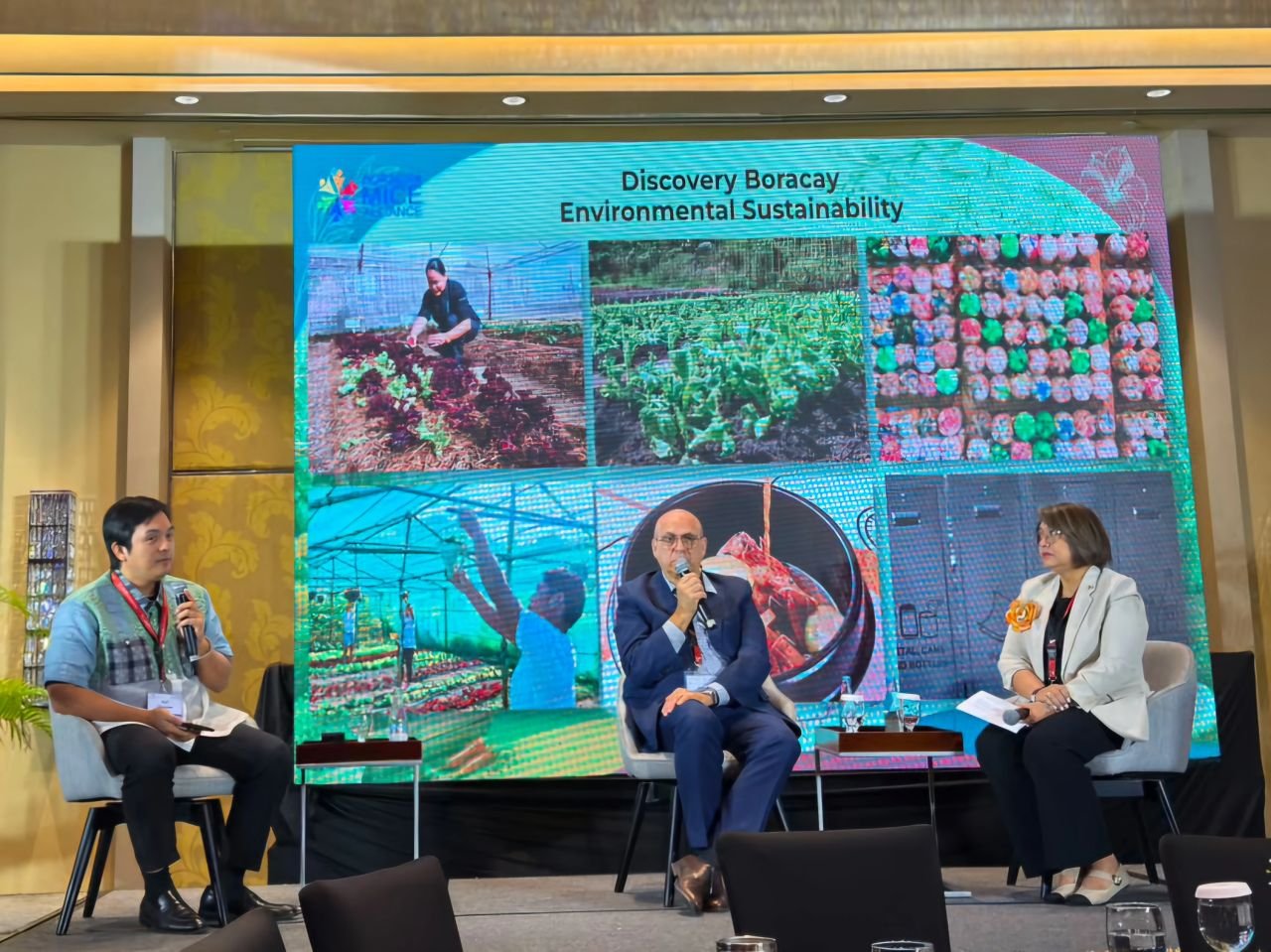
From Farm to Fork Panel. From left: MAD Travel’s Raf Dionisio, The Farm at San Benito, Autograph Collection GM Giuliano Callegaro, and Boracay Newcoast Area GM Maia Israel. Credit: TIEZA
The Farm at San Benito, Autograph Collection in Batangas currently supplies about 50% of its restaurant needs from a four-acre operation worked by 27 gardeners, with plans to expand substantially over the next six months. The microclimate around Mount Banahaw and Mount Makiling provides typhoon protection and reliable water access—conditions that, as General Manager (GM) Giuliano Callegaro acknowledged, few Philippine properties are fortunate enough to have.
Boracay Newcoast operates under entirely different constraints. Area General Manager Maia Israel shared that as a vertical hotel development with limited land, her team has turned unused corners of its buildings into small growing spaces, using black tents to manage the island's intense heat. Most of the output goes to the staff cafeteria, with seasonal surplus occasionally reaching guest-facing operations. It is not a significant percentage of total vegetable needs. Not yet. None of the staff were trained growers, though a chief steward with a personal interest became the driver, pulling in the chefs and cafeteria team.
Both are genuine efforts. Neither is a sector-wide solution.
In both cases, the constraint was not land or willing farmers. It was the lack of systems that make local sourcing work reliably at commercial scale. Callegaro was candid about the structural mismatch: large hospitality companies operate with formal procurement requirements—invoices, receipts, tax documentation—that many small-scale farmers either cannot or will not provide. The farmer who supplies reliably for two weeks and then disappears is not simply unreliable. They are often operating in an informal economy that the formal hospitality procurement structure was never designed to integrate.
The workarounds being piloted—seed provision to nearby farmers, harvest agreements, university partnerships for planting schedules, local government unit (LGU)-facilitated producer networks—show real promise but lack the structural depth to hold under pressure. Moderator Raf Dionisio, Co-Founder of MAD Travel, pointed to the Good Shepherd Sisters' ube (purple yam) farming model as one functional example of a structured aggregation approach: formalized forecasting, seed provision, guided documentation, and a wide enough supplier base to absorb production gaps. That kind of institutional scaffolding is what separates a working local sourcing program from a good idea that collapses when the first supplier goes quiet.
For hotel operators exploring this territory, the questions are practical: Who within your organization is accountable for this relationship? What procurement flexibility do you actually have? And is your commitment long enough to absorb the early failures that come with building something genuinely new?
Green Teams Stall Without Dedicated Ownership and Measurable Baselines
The "Green Teams: Charting a Sustainable Course" panel discussion cut straight to one of the summit's clearest operational insights: sustainability programs without dedicated human ownership and baseline data will always be outcompeted by daily operational priorities.
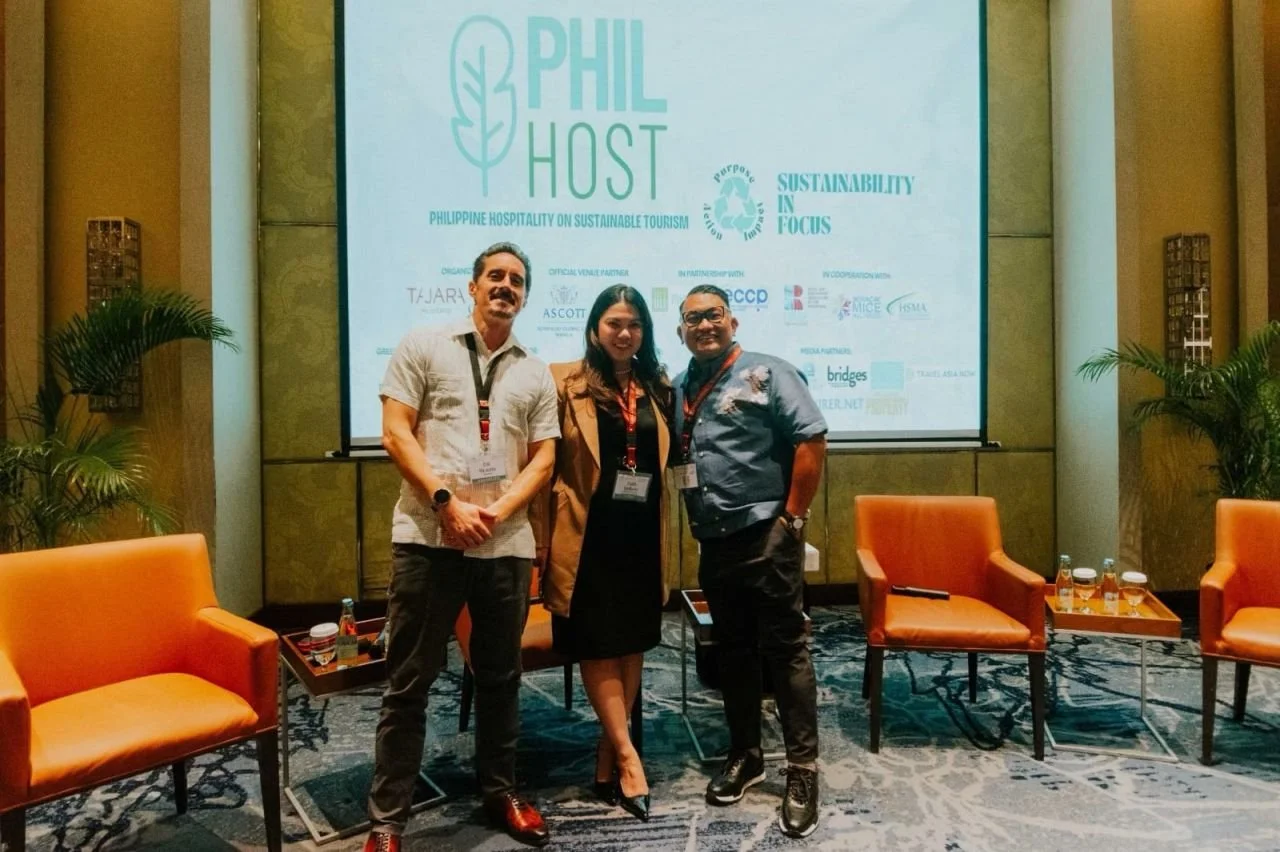
Green Teams: Charting a Sustainable Course panel. From left: Greenview Founder & CEO Eric Ricaurte, The Ascott Philippines’ Faith Quijano, and Discovery Coron's Joegil Escobar. Credit: Cyndy Tan Jarabata
The Ascott Philippines has built a cross-functional sustainability council anchored by the General Manager as the de facto lead, with representatives from engineering, housekeeping, procurement, food and beverage, people and culture, and marketing. GM of Citadines Roces Quezon City and Country Sustainability Co-Champion Faith Quijano reported that The Ascott Philippines has achieved GSTC certification for 95 percent of its properties—the first Ascott country globally to reach that milestone—and has generated approximately PHP 59 million (roughly USD 955,000) in savings through a switch to wheat straw packaging in bathroom amenities.
The procurement team's role in that outcome deserves specific attention. The conventional assumption is that procurement resists sustainability initiatives because sustainable products cost more. In practice at Ascott, procurement became the team that identified long-term cost reductions the sustainability function alone could not have delivered. The cage-free egg transition tells a similar story: previously more expensive, now increasingly cost-competitive as supplier ecosystems have matured.
Discovery Coron's EcoConserve program takes a different structural approach: four specialized committees—FEW (Fuel, Energy, Water) Champs; Sea Guardians for marine preservation; Green Thumb for land-based initiatives; and GarMa Task Force for garbage management—with all staff participating across committees. GM Joegil Escobar was candid about the challenge of building genuine engagement rather than compliance participation, and introduced a point-based incentive system to sustain involvement beyond the initial rollout. But he was clear that the points are not what carries it. "It's leading by example, really," he said. "If I don't do it myself, the staff would say, my GM isn't participating anyway."
Both GMs stressed one operational point: someone has to be responsible for the data. Escobar described the work of establishing sustainability metrics as painstaking, and not something that can simply be added to an existing role as a secondary responsibility. The organization needs one person whose primary accountability is sustainability tracking, baseline management, and ongoing monitoring. Without that, you cannot improve what you are not measuring, and you cannot build the business case that a CFO needs to see.
This is not organizational structure for its own sake. It is the operational infrastructure that allows a sustainability program to outlast its founding champion.
For a closer look at how properties can embed sustainability across every level of the team, see our feature Sustainability Beyond the Manager: Engaging Your Entire Team.
When Cost-Cutting Gets Mistaken for Sustainability
The "Beyond the Hype: Building Authentic Sustainability" panel, moderated by Michelle Barretto, CEO of Vitamin B, focused on the difference between sustainability initiatives that support the business and cost-cutting dressed up as sustainability.
August Samala, COO of The Henry Hotels, highlighted one of the pillars of sustainability: financial viability. A property that adopts sustainability measures it cannot sustain commercially will not last, and when a hotel fails, the local suppliers and communities tied to it lose as well. He was also clear that viability should not come from stripping out the basics of the guest experience. Hot water, properly functioning air conditioning, and core service quality should not be treated as negotiable. Measures such as linen and towel reuse make sense when they are offered as a guest choice, not when they are used to cut service costs behind an environmental rationale.
Christian Pirodon, Founder of CP Hospitality, pushed the critique further. He pointed to the kinds of substitutions that are often presented as sustainability wins but feel, to the guest, like visible downgrades: unsealed glass water bottles of uncertain origin, or cheaper amenity presentations introduced under a green label without improving trust, design, or hygiene confidence. His point was not that alternative delivery systems are inherently flawed. It was that a hotel cannot assume any move away from the old format will automatically be read as responsible. If the measure feels careless, unclear, or visibly cheaper, many guests will see cost-cutting before they see sustainability.
Richard Masselin, GM of Sheraton Manila Bay, shifted the discussion to where the better opportunities usually sit: in the building's systems. Energy efficiency gains from chillers, pumps, air-conditioning controls, and better monitoring can reduce consumption without degrading the stay. He offered a familiar operational example: ballrooms and lobbies routinely cooled far below comfort levels, to the point that guests complain. Fixing that costs nothing. It saves energy and improves the experience simultaneously.
He also described how Marriott's balanced scorecard ties both property and GM performance to measurable sustainability outcomes, making the program less dependent on personal goodwill and more embedded in management discipline.
Sustainability can and should generate real savings. But the source of those savings matters. So does the honesty with which they are communicated. Reducing waste through a hotel’s own systems is one thing. Shifting the cost of a business decision onto the guest and calling it sustainability is another.
Why Adaptive Reuse Still Matters Most
The "Sustainable Spaces, Lasting Impact" session reinforced a point still underemphasized in most development conversations: adaptive reuse of existing structures is, almost by definition, the most sustainable building decision.

Sustainable Spaces, Lasting Impact panel. From left: Greenview Founder & CEO Eric Ricaurte, Miaja Design Group’s Isabelle Miaja, IHG Hotels & Resorts’ Chris Anklin, and Robinsons Hotels & Resorts’ Barun Jolly. Credit: Cyndy Tan Jarabata
Chris Anklin, Senior Director of Development for Southeast Asia and Korea at IHG Hotels & Resorts, noted that approximately 40 percent of the company's deals across Southeast Asia now involve conversions or adaptive reuse. The logic is straightforward. Embodied carbon in existing structures has already been spent. Renovation preserves that investment. New construction cannot.
The Henry Hotels treats this as a standing principle. In an earlier panel, August Samala described the company's commitment to renovation over demolition: as long as an existing structure is safe to renovate, they prioritize that path and weave the property's heritage into the guest narrative. The harder conversation is with shareholders who want materials sourced from lower-cost mass producers rather than local artisans. The long-term case—that locally sourced materials create a more distinctive guest experience and property story—is clear, but it requires sustained advocacy across multiple stakeholder conversations.
Barun Jolly, SVP of Robinsons Land Corporation and Business Unit GM of Robinsons Hotels & Resorts, offered a useful renovation framework: do not let renovation become purely an aesthetic exercise. Invest in the building systems where the return on sustainability investment is most measurable. New chillers, cooling towers, and HVAC can deliver ROI within four to five years against a 15-year asset lifecycle, and that calculation becomes more favorable as energy costs rise.
Isabelle Miaja, Managing and Creative Director of Miaja Design Group, identified a more intangible but equally real dimension: guests increasingly respond not just to visible sustainability features, but to the felt sense of authenticity that comes from a place with genuine history and local character. That is difficult to manufacture in a new build. It is considerably easier to preserve in a thoughtful renovation.
Reef Rehabilitation Is Infrastructure, Not CSR
Che Adlawan, Lead for Sustainable Livelihood and Social Inclusion at Rrreefs, made a point that deserves more attention than it typically receives: coral reefs are critical infrastructure. Not a backdrop. Not a CSR talking point. Infrastructure.
Healthy reefs protect coastlines, sustain fisheries, support water quality, and directly drive the quality of the visitor experience that coastal tourism depends on. When reefs degrade, the consequences are operational, not just ecological. Properties become more exposed to wave energy and erosion. The marine environment that guests come to see diminishes. The destination's competitive appeal erodes with it.
Rrreefs' modular clay reef structures—locally produced from natural clay, designed to support natural coral settlement and marine life recruitment—were deployed in Siquijor in December 2023 in partnership with Accor Group, rehabilitating a 25 sqm degraded reef area. The model is designed to generate measurable outcomes: coral recruitment rates, fish abundance, habitat creation, and community participation data that can support ESG reporting.

Siquijor impact report. Credit: Rrreefs
Read the full impact report here.
"Beyond ecological outcomes, our work is designed to create pathways for sustainable livelihoods, meaningful community participation, and long-term local ownership," shared Adlawan. "In this way, reef rehabilitation becomes more than a standalone conservation activity. It serves as a collaborative platform for environmental recovery, community resilience, and private sector engagement in sustainable coastal development."
The value of the Rrreefs model at this stage is in demonstrating what structured, science-backed private-sector investment in natural coastal infrastructure can actually look like. Coastal properties that wait for government or conservation organizations to lead on reef rehabilitation are accepting a business risk — erosion vulnerability, declining marine experiences, weakened fisheries supply — that they have some capacity to address directly.
"The question is no longer whether businesses like you should invest in nature. The question now is, how do we do that? Hospitality investors increasingly seek measurable impact. Our model provides quantifiable indicators such as number of reef structures deployed, coral recruitment, fish abundance, habitat creation, community participation, livelihood opportunities, and educational engagements. And these metrics can support ESG reporting, sustainability reporting, and stakeholder communications."
Resilience Is Built Differently From One Market to the Next
The “Building Resilient Developments” panel returned to a simple premise: resilience is not a universal checklist. In hospitality, it depends on where a property is, how large it is, and what kind of pressures it is likely to face.
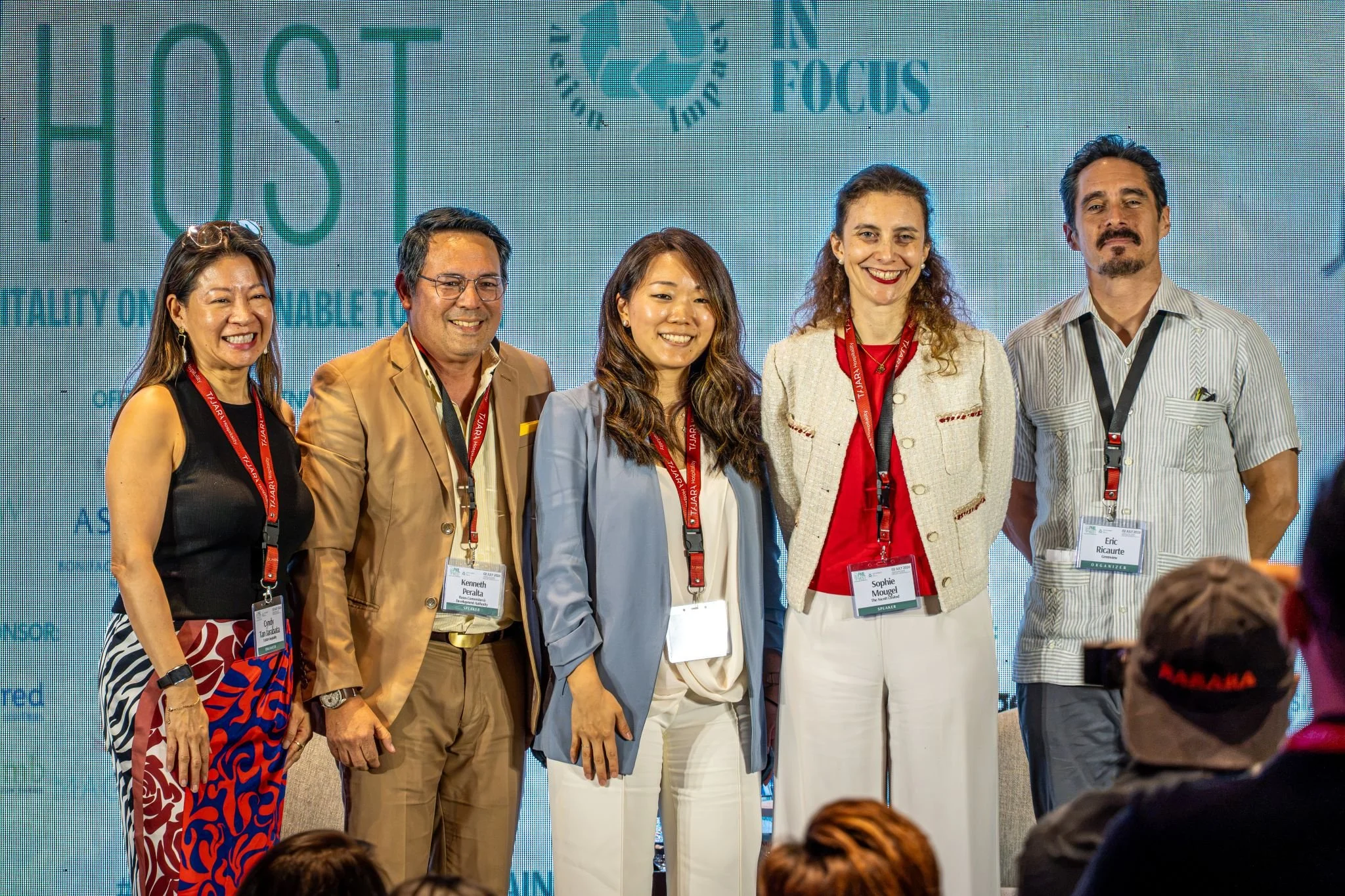
Building Resilient Developments panel. From left: TAJARA Hospitality’s Cyndy Tan Jarabata, Bases Conversion & Development Authority’s Kenneth Peralta, Hilton Hotels & Resorts’ Maria Ariizumi, The Ascott Limited’s Sophie Mougel, and Greenview Founder & CEO Eric Ricaurte. Credit: The Ascott Limited Philippines
Sophie Mougel, VP Strategy & Regional GM Malaysia & The Philippines, The Ascott Limited, argued that resilience should not be treated as a narrow crisis-response function. It is part of whether a property remains competitive. Hotels have to adapt not only to disruptions, but also to changing traveler expectations, market cycles, and longer-term structural shifts. In that sense, resilience is less about emergency reaction than about whether an asset can continue to perform over time.
Maria Ariizumi, VP Development for Southeast Asia at Hilton Hotels & Resorts, brought the discussion down to the level of individual markets. In the Philippines, resilience looks different from one destination to another. In Boracay, water and waste management may be the priority. In Palawan, infrastructure and ecosystem protection carry more weight. In Siargao, climate resilience and recovery mechanisms move higher up the list.
She also made a practical point about scale. Large assets can justify investments that smaller properties cannot. Hilton Manila’s nearly 1,000-panel solar installation is viable because of the size and operating profile of the property. A smaller hotel in a different market would have to make the case differently.
Kenneth Peralta, VP Investment Promotions & Marketing of Bases Conversion & Development Authority, added the infrastructure perspective. Using New Clark City as an example, he pointed to systems such as district cooling, designed to reduce air-conditioning costs across a larger development rather than at the level of a single building. It was a reminder that some of the most consequential sustainability decisions are made in utilities, transport, and site planning long before they appear in a hotel’s reporting framework.
Talent Strategy Has Become a Sustainability Issue
The "NextGen Leaders: Taking Action Now" panel looked at sustainability around a challenge the industry rarely names directly: its ability to build and retain the workforce it depends on.
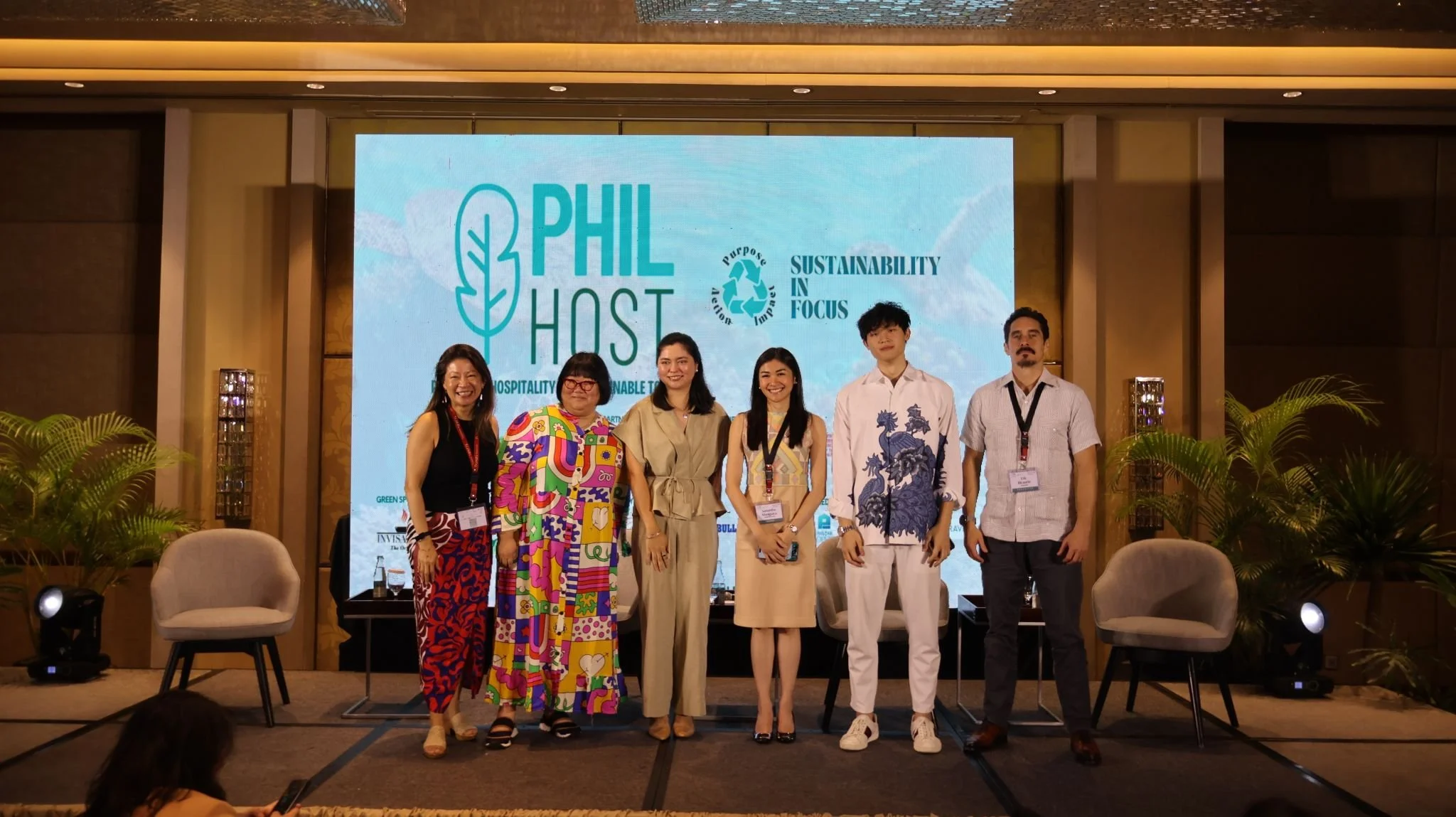
NextGen Leaders: Taking Action Now panel. From left: TAJARA Hospitality’s Cyndy Tan Jarabata, The Ascott Limited’s Adeline Phua, Torre Lorenzo Development Corporation’s Monica Lorenzo, AppleOne Group’s Samantha Manigsaca, BE Group’s Giles Benedicto, and Greenview Founder & CEO Eric Ricaurte. Credit: The Ascott Limited Philippines
Monica Lorenzo, Director for Leisure & Business Development of Torre Lorenzo Development Corporation, described the reality many hospitality employers are dealing with: Filipino talent is in demand internationally, often at salary levels local operators cannot match. Under those conditions, trying to stop people from leaving is rarely the most useful strategy. The more realistic approach is to build careers with stronger development paths, more vigorous investment in training, and workplaces that make people want to stay—or return.
Giles Benedicto, Associate Director of Corporate Finance at BE Group, widened that view by linking workforce questions to the long-term shape of development itself. Hospitality assets are built for decades, not for short cycles, and sustainability has to be considered on that timeline. Leadership, culture, and talent pipelines are part of that equation. If a property cannot retain the people it needs to run well, its resilience is weakened no matter how advanced the infrastructure may be.
Samantha Manigsaca, VP for Hospitality of AppleOne Group, pushed the point further. By 2036, she argued, sustainability should no longer sit in the category of special initiatives. Practices such as reducing plastic use should already be standard operating procedures. How quickly that happens depends partly on leadership, but more fundamentally on who is entering the industry and what they are being taught to treat as normal.
The discussion placed workforce issues at the heart of the broader question of whether a property or destination can hold its standard over time. A market that cannot develop, retain, and re-attract talent will struggle to sustain quality and meaningful performance.
The Business Case Often Depends on How You Explain It
The "CEO PANEL: The Sustainability Blueprint: Balancing Growth and Green" returned to a familiar problem in sustainability efforts: a measure can be commercially sound and still stall if it is explained in terms that do not connect with the people responsible for implementing it.
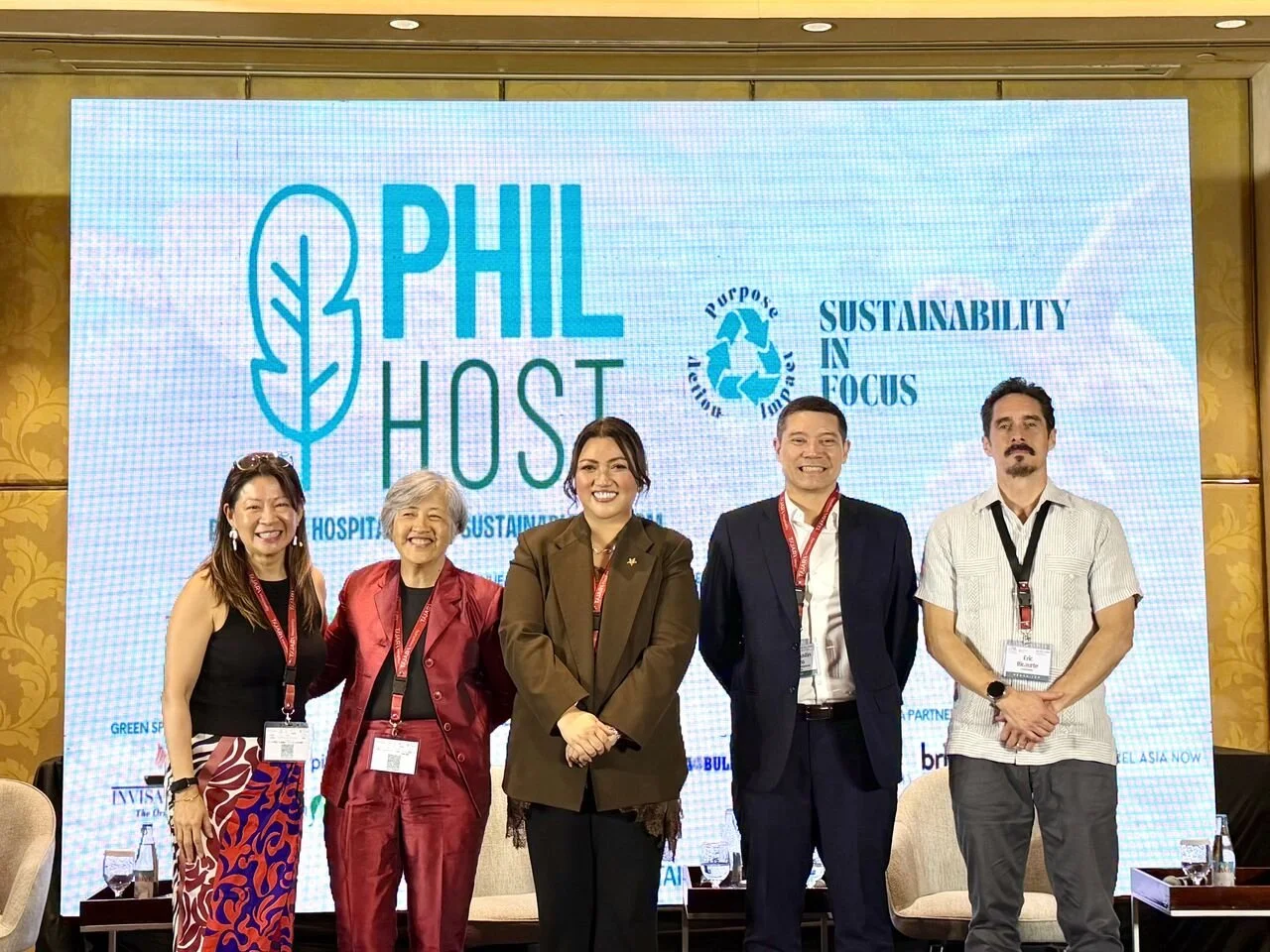
CEO Panel. From left: TAJARA Hospitality’s Cyndy Tan Jarabata, Amb. Chantale Wong, Megaworld Hotels & Resorts GM Cleo Albiso, Torre Lorenzo Dev’t Corporation CEO Tomas Agustin Lorenzo, Greenview Founder & CEO Eric Ricaurte. Credit: Cyndy Tan Jarabata
Tomas Lorenzo, CEO of Torre Lorenzo Development Corporation, gave a simple example from one of the group's island properties. A heat-exchange system linked to the air-conditioning cycle heats water and reduces the need for electric or solar water heaters. The savings were real, but technical explanations did not land with the operating team. The point only became clear when the savings were translated into something concrete: the equivalent of switching off 280 electric irons at the same time. Nothing about the technology changed. The explanation did.
Cleofe Albiso, Managing Director of Megaworld Hotels & Resorts, added a broader development perspective. Megaworld’s regional projects in places such as Palawan are not just expansion plays. They are long-horizon investments in integrated communities, where hospitality is part of a larger ecosystem of offices, schools, retail, and services. That kind of development makes the business case differently. Rather than letting tourism growth extract value from a destination, this integrated model is designed to keep jobs, services, and economic activity anchored in the communities where that growth is happening.
Ambassador Chantale Wong suggested two tools that can help close the financing gap: carbon finance and impact investment. Carbon finance supports projects, such as conservation or clean energy, that generate verified emissions reductions. Impact investment channels capital into projects designed to deliver measurable environmental or social returns alongside financial ones.
Wong argued that both are especially relevant for natural-capital projects: initiatives that protect or restore ecosystems whose value to communities and economies is real but rarely captured on a balance sheet.
Sustainability projects too often get evaluated through conventional short-term financial filters. Widening the capital framework means decision-makers have more tools available when the numbers don't fit neatly into a standard ROI model.
The Questions to Ask in Your Own Property
PHILHOST 2026 did not produce a universal playbook, and that is precisely the point: each business faces a different set of constraints, trade-offs, and opportunities. What works at The Farm at San Benito, with its favorable microclimate, century-long land use, and 27-person gardening team, will not transfer directly to a vertical hotel on a small island. What works for Ascott's multi-property GSTC certification program requires the corporate infrastructure and sustained investment that a 60-room boutique property simply does not have.
What does transfer is the discipline of asking the right operational questions before committing to any sustainability initiative.
Who owns the data?
If no single person has accountability for your sustainability metrics and baseline tracking, your sustainability program will drift. This does not require a full-time sustainability director at every property, but it requires a named person with protected time and real authority over the numbers.
Is your green team structured to survive beyond the leader who built it?
Passion matters enormously in early-stage sustainability programs. But programs that depend entirely on one champion are fragile. Cross-functional structure, embedded KPIs, and onboarding integration—as Ascott and Discovery Coron have built—create institutional durability.
Are your supply chain ambitions matched by your procurement flexibility?
Local sourcing requires the organizational capacity to work with informal producers, absorb inconsistency in the early stages, and invest in the relationship infrastructure that makes consistency possible over time. If your procurement system cannot accommodate that, the aspiration will remain an aspiration.
Are you investing in natural infrastructure as seriously as built infrastructure?
For coastal properties, reef health, mangrove cover, and water quality are not environmental side projects. They are business assets. The cost of ignoring them will eventually show up in guest experience quality, coastal vulnerability, and destination decline.
Are you sizing your sustainability investment to your property scale and location?
A large urban hotel has different leverage points than a remote island resort. Invest where the return is real for your specific context, not where the template says you should.
Can you explain the financial case in language your owners and operators will actually hear?
If the answer is no, the initiative will not survive the next budget cycle.
That was PHILHOST 2026 at its most useful: treating sustainability as something that has to survive operations. These are the questions worth asking in your own property.
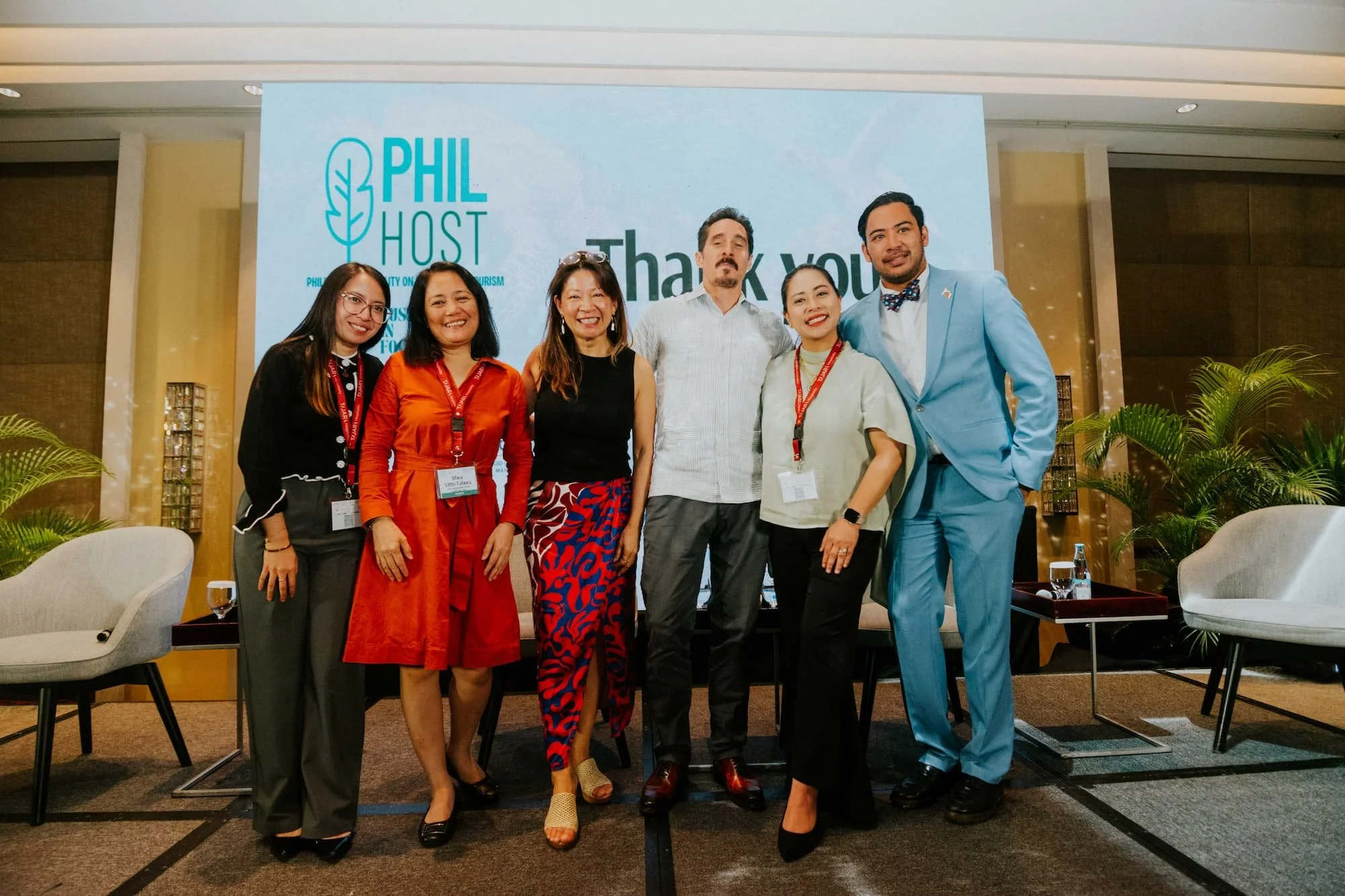
Asia Sustainable Travel (AST) proudly supports PHILHOST as a media partner. From left: Tourism Infrastructure and Enterprise Zone Authority (TIEZA)’s Lahren Lee Caranay, AST’s Rhea Vitto Tabora, TAJARA Hospitality’s Cyndy Tan Jarabata, Greenview Founder & CEO Eric Ricaurte, TIEZA’s Karen Mae Sarinas-Baydo, and National Parks Development Committee’s Jezreel Apelar. Credit: TAJARA Hospitality